“`html
Pleated Inkcap (Parasola plicatilis)
Table of Contents
A delicate, ephemeral lawn-dweller featuring a pleated, umbrella-like cap that typically emerges overnight and withers away by midday.

Quick Facts
- Edibility: Inedible (Too fragile and lacks culinary value)
- Season: Spring to Autumn (commonly peaking after heavy rain)
- Habitat: Lawns, grassy areas, parks, and roadsides
- Spore Print: Black
Identification & Morphology
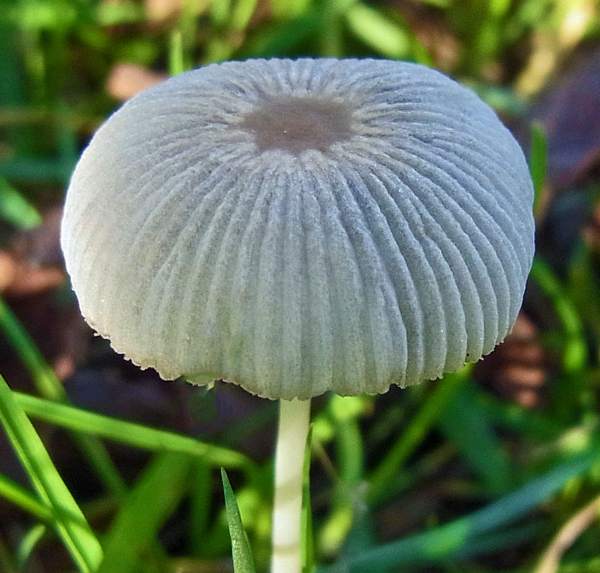
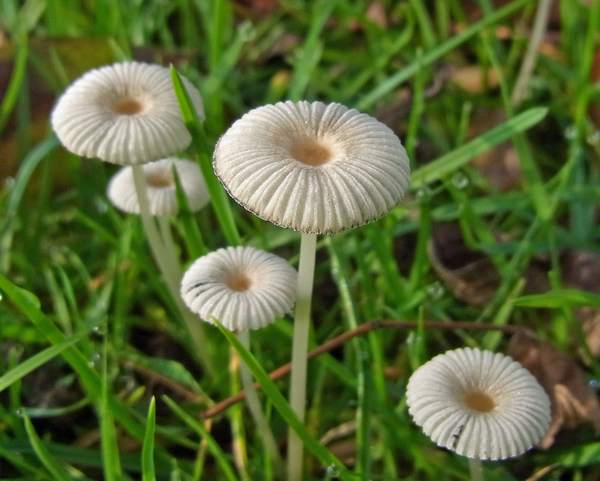
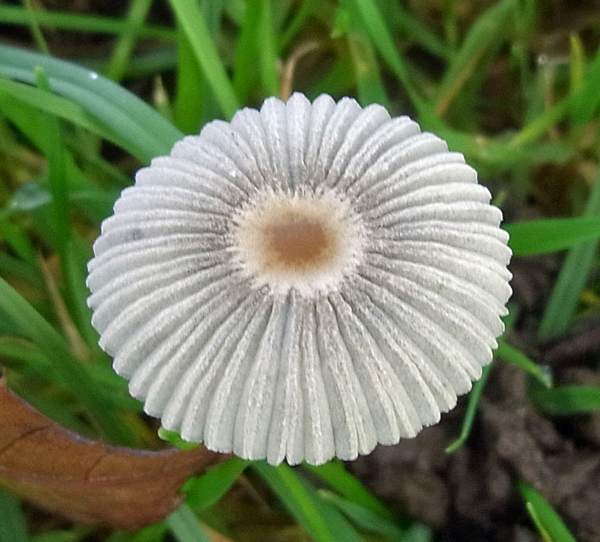
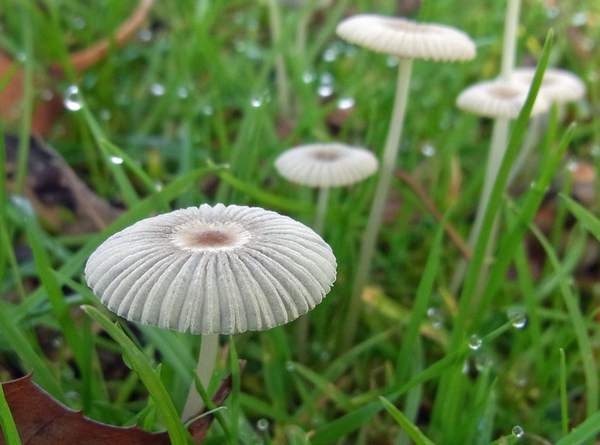
- Cap: Measuring 1 to 3.5 cm across, starting egg-shaped before expanding to become convex or flat with a depressed center. It is deeply grooved or pleated like a paper parasol, translucent, and pale greyish-brown with a small brownish-orange center button.
- Gills: Thin, narrow, and grey, eventually turning black as spores mature. Unlike some larger inkcaps, they tend to dry out rather than melting into a heavy fluid.
- Stem: Extremely thin, hollow, translucent white, and fragile, snapping easily under minimal pressure.
- Flesh: Paper-thin and virtually nonexistent, lacking any distinct odor or taste.
Habitat & Blooming Time
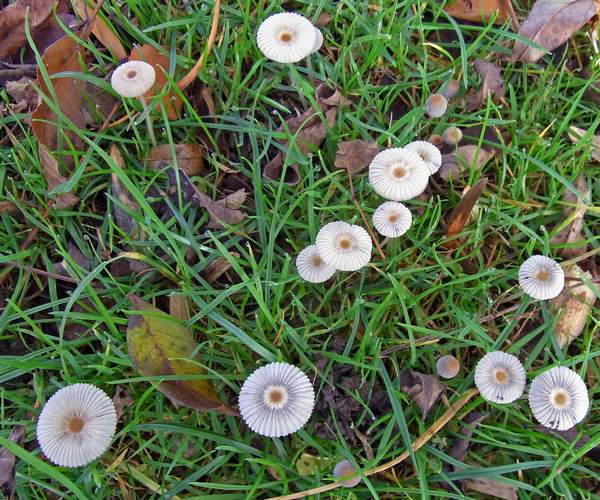
The Pleated Inkcap is a saprotrophic species that feeds on decaying organic matter in well-manicured or nutrient-rich soil. It is frequently found scattered or in small groups on residential lawns, meadows, and golf courses. Fruiting bodies materialize rapidly overnight following heavy rainfall and high humidity, only to wither or collapse under the weight of the midday sun.
Edibility & Toxicity
While the Pleated Inkcap is non-toxic and not known to contain dangerous poisons, it is universally classified as inedible for practical purposes. Its paper-thin texture, minute size, and exceptionally brief life cycle mean it offers zero culinary substance. Furthermore, because it falls into the category of “Little Brown Mushrooms,” beginners should avoid harvesting small ephemeral species due to the risk of confusing them with potentially toxic lookalikes.
Pleated Inkcap Gallery: Click to enlarge
Frequently Asked Questions
Is the Pleated Inkcap edible?
No, while it is non-toxic, the Pleated Inkcap is classified as inedible because it has paper-thin flesh, virtually no substance, and collapses almost immediately.
Why do Pleated Inkcaps disappear so quickly?
They are ephemeral mushrooms that typically push up overnight during damp conditions and quickly wither, dry out, or collapse under the heat and weight of the midday sun.
Where do Pleated Inkcaps grow?
They are saprotrophic fungi that feed on decaying organic matter and commonly appear scattered or in small groups on well-manicured lawns, grassy parks, meadows, and roadsides.
What color is the spore print of Parasola plicatilis?
The spore print of the Pleated Inkcap is black, as its narrow gills darken and mature as the mushroom ages.

This work is licensed under a Creative Commons Attribution 4.0 International License.
You are free to use, share and adapt any of the images on this page, under the condition we receive a followed backlink to our website https://diversegardens.co.uk as the image source.