Dryad’s saddle Cerioporus squamosus
Table of Contents
A distinctive bracket fungus featuring a pattern reminiscent of a bird’s wing, the young tender caps offer a mild, earthy taste with a hint of fresh watermelon rind.

Quick Facts
- Edibility: Edible (Choice when young)
- Season: Spring to Autumn (Peak in Spring)
- Habitat: Hardwood forests (stumps, fallen logs, and living trees like elm, beech, and ash)
- Spore Print: White
Identification & Morphology
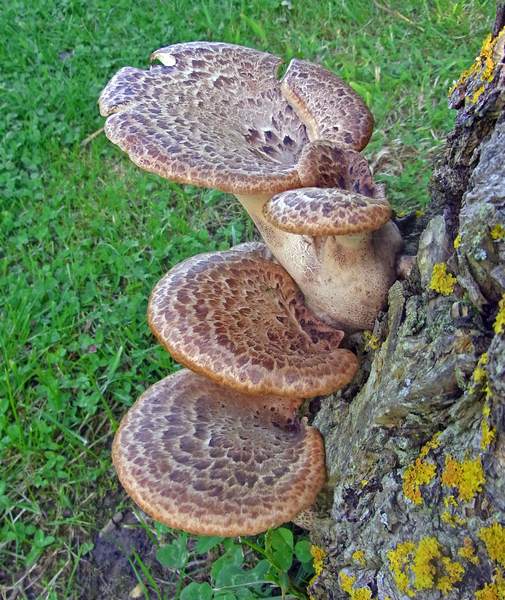
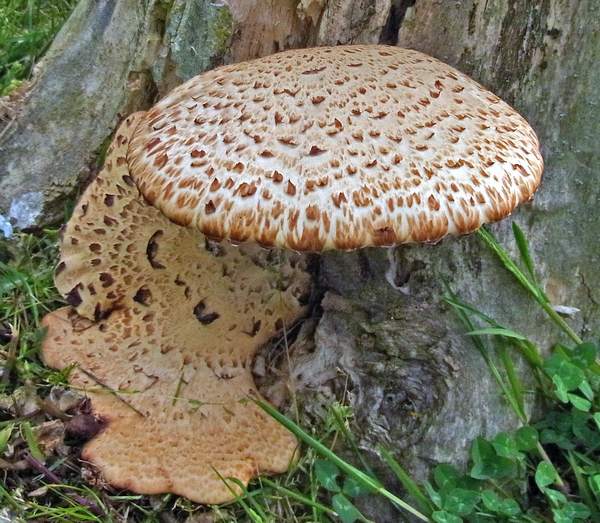
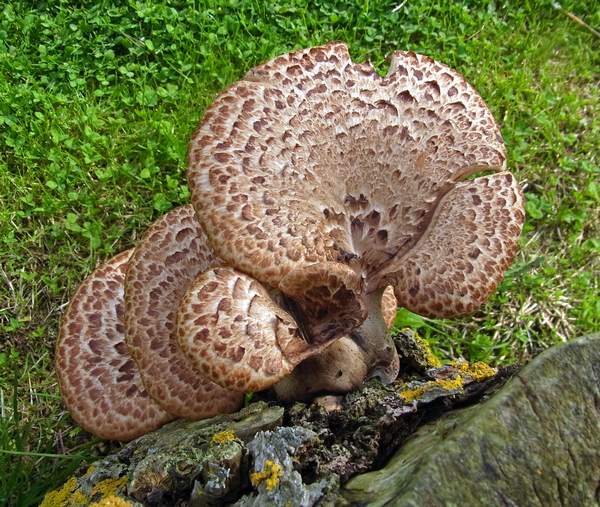
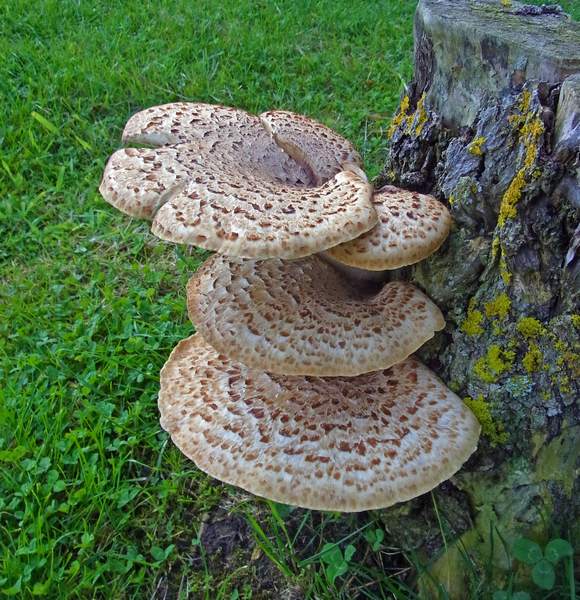
- Cap: Large, fan- or kidney-shaped brackets measuring 8 to 30 cm across. The upper surface is cream-to-yellowish and covered in distinctive concentric dark brown scales (“squamules”) that resemble a pheasant’s back.
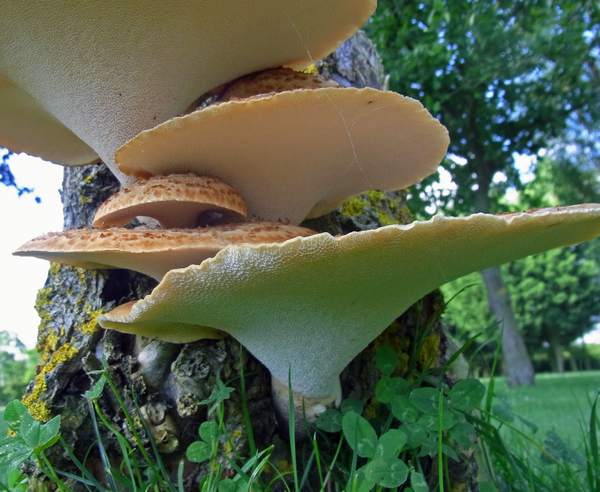
- Gills: Lacks true gills; instead, the underside features tightly packed, angular, off-white-to-ochre tubular pores that run a short way down the stem.
- Stem: Short, thick, and stout (eccentric or lateral attachment to the wood), featuring very firm flesh that darkens to near-black at the base.
- Flesh: Thick, white, and succulent when young, but quickly turns tough, rubbery, and corky as the mushroom matures. Young specimens give off a characteristic faint aroma of watermelon rind or cucumber.
Habitat & Blooming Time
Dryad’s Saddle is a saprobic and occasionally weakly parasitic white-rot fungus. It is widely distributed across the UK, North America, Europe, and Asia. Fruiting most heavily in spring (frequently overlapping with morel season) and experiencing a secondary smaller flush in autumn, it grows singly or in overlapping tiers on dead, dying, or damaged broad-leaf hardwoods.
Edibility & Toxicity
It is safe to eat, but only when harvested young. When tender, it can be sliced thinly and cooked slowly over low heat, though older specimens become completely inedible due to a rubbery, corky texture and a tendency to become maggot-ridden. No dangerous look-alikes exist in the UK or Europe that share its combination of large bracket shape, pheasant-back scales, and decurrent angular pores, making it an excellent, beginner-friendly target for foragers.
Foraging Disclaimer
Wild mushroom identification and foraging carry inherent risks. The information provided on this website is for educational and informational purposes only and should not be considered professional mycological advice. Never consume any wild fungus unless you have 100% certainty of its positive identification. Always exercise caution, verify with multiple trusted field guides, and consult local experts before foraging or consuming wild mushrooms.
Dryad’s Saddle: Frequently Asked Questions
When is the best time to find Dryad’s Saddle?
How can you tell if Dryad’s Saddle is too old to eat?
What do young Dryad’s Saddle mushrooms taste like?
Are there any toxic look-alikes to watch out for?
Where does Dryad’s Saddle typically grow?

This work is licensed under a Creative Commons Attribution 4.0 International License.
You are free to use, share and adapt any of the images on this wildflower gallery page, under the condition we receive a followed backlink to our website https://diversegardens.co.uk as the image source.