Fly Agaric Amanita muscaria
Table of Contents
The Fly Agaric (Amanita muscaria) is perhaps the most instantly recognizable mushroom in the world. With its striking bright red cap adorned with white, fluffy remnants of the universal veil, it stands as the quintessential “toadstool” of folklore, children’s storybooks, and woodland imagery.

Family: Amanitaceae
Fruiting season: September – November
Colour: Red – white
Cap width: 8 – 20cm
Height: 8 – 20cm
Habitat: Woodland
Edible: Inedible – Toxic
General Information
Fly Agaric is native to the UK and is typically found on lighter soils in woodland and heathland sites. It is often found growing amongst certain species of trees, particularly Birch (Betula pendula), forming a mycorrhizal relationship with it. It can also be found amongst pine, spruce, fir, beech, and oak trees.
The fly agaric has cultural significance in various myths, folklore, and traditions. It is often associated with fairy tales, flyting (an old Norse poetic tradition), and shamanic rituals.
Identification
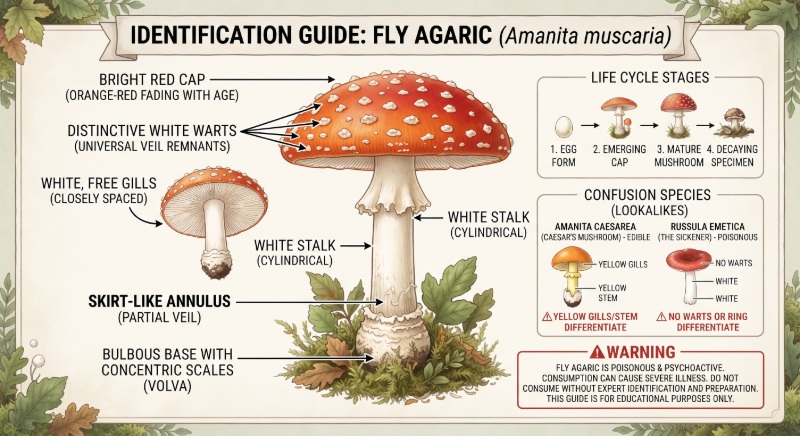
Recognizing the Fly Agaric in the wild is relatively straightforward due to its distinct morphology:
- The Cap: Bright red, scarlet, or orange-yellow, typically measuring between 8 to 20 cm across. It is usually covered in scattered white to pale yellow flaky remnants of the universal veil (known as warts).
- Gills: Free from the stem, crowded closely together, and white in color.
- Stalk (Stem): White to yellowish, cylindrical, and featuring a bulbous base that may show concentric rings of veil remnants.
- Ring (Annulus): Features a distinct, skirt-like white ring hanging from the upper portion of the stalk, left behind when the partial veil ruptures.
Toxicity
Unlike many edible woodland mushrooms, the Fly Agaric contains potent psychoactive and neurotoxic compounds rather than standard mushroom toxins like amatoxins. Its primary active constituents are muscimol and ibotenic acid.
- Symptoms of Ingestion: Ingestion can lead to a wide array of neurological and physiological symptoms, including dizziness, nausea, muscle twitching, drowsiness, confusion, visual and auditory distortions, and delirium.
- Severity: While fatalities are exceptionally rare, accidental consumption causes significant physiological distress, making it a hazardous species for novice foragers.
Uses
Despite its toxicity, the Fly Agaric has a rich history of human interaction and cultural use:
- Historical and Shamanic Traditions: Indigenous peoples in parts of Siberia and Northern Europe historically used the mushroom in religious and shamanic rituals to induce altered states of consciousness.
- Pest Control: True to its common name (“fly” agaric), historical traditions involved crumbling the mushroom cap into milk or sweet liquids to act as an insecticide, stunning or killing houseflies that ingested it.
- Pop Culture and Folklore: Its iconic appearance has cemented its status in European folklore as a symbol of magic, fairy tales, and winter holiday imagery.
Edibility
- Is it edible? No, it is not considered safely edible.
- Preparation Traditions: While some historical or regional culinary traditions (such as specific European and Japanese practices) describe boiling, parboiling, or leaching the mushroom multiple times to discard the water-soluble toxins, doing so carries a high risk of error.
- Foraging Guidance: Because improper preparation or misidentification can lead to severe poisoning, mycologists and wildlife experts strongly advise against foraging or consuming Amanita muscaria.


Fly Agaric: Frequently Asked Questions
What is Fly Agaric?
Why is it called “Fly” Agaric?
Is Fly Agaric edible?
What makes Fly Agaric toxic?
What are the symptoms of poisoning?
Can you find Fly Agarics in the UK?

This work is licensed under a Creative Commons Attribution 4.0 International License.
You are free to use, share and adapt any of the images on this page, under the condition we receive a followed backlink to our website https://diversegardens.co.uk as the image source.