Borage Borago officinalis
Table of Contents
Borage, also known as ‘starflower’ or ‘bee bush’ is a bristly, annual herb found on cultivated land, disturbed verges and waste areas. Flowering from May – September, it thrives in sunny conditions and is extremely drought tolerant. It has many uses, both medicinal and as a food plant.

Plant family: Boraginaceae
Aliases: Starflower, bee bread, bee bush, bugloss, tailwort
Flowering period: May – September
Flower colour: Blue, (sometimes white or pink)
Preferred soil type: Most types, well drained
Habitat: Field margins, waste areas, disturbed ground
Status: Common
General information
Borage, sometimes referred to as ‘starflower’ due to the star shape of it’s flowers petals, is not a true native of the United Kingdom. It can be confused with green alkanet as there are similarities between the two. It’s a bristly, annual (on occasions a perennial) herb that typically grows to a height of 60cm and is grown commercially for it’s seed oil, which is extracted from the plants leaves.
Borage is most frequently found in areas where the soil has been disturbed, such as building sites, roadsides, railway tracks, waste ground and field margins. It thrives in moist, but well drained soils and prefers sunny locations, although it will grow in shade, proving there is ample warmth. Although it’s an annual plant, borage self seeds freely and should return in subsequent years.
Identification
Flowers: The flowers are bright blue with white centres and consist of 5 triangular pointed petals, each having 5 purple – black stamens that taper to a point. Each flower is between 15-25mm in diameter.
Leaves: Once mature, the leaves are bristly and hairy all over, they are alternate, deeply veined and oval, and between 5–15 cm long.
Value for wildlife

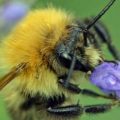
Borage provides a rich source of pollen and nectar and is a real favourite with bumble bees, honey bees and solitary bees as they feed on the open flowers that are easy to access. It’s not just bees that love this wildflower, butterflies and hoverflies are also attracted to it, overall a great plant for pollinators.
Uses for borage
Borage has served many purposes, both medicinal and as a food plant. With a taste that’s very much like cucumber, it has many culinary uses. Tender, young leaves can be used as salad greens, while the flowers can be tossed in salads or used as a garnish for drinks and deserts.
It can also be added to soup, sauces and jelly and the leaves can be used to make herbal tea.
The seeds are used to make borage oil, which is an excellent source of gamma-linolenic acid (GLA), an omega six fatty acid, that is believed to help reduce inflammation.
Borage can also be used to treat skin conditions, rheumatoid arthritis and asthma. However, there can be adverse side effects for certain groups of people and it shouldn’t be taken without consulting a healthcare professional.
Borage images
Click to enlarge


This work is licensed under a Creative Commons Attribution 4.0 International License.
You are free to use, share and adapt any of the images on this page, under the condition we receive a followed backlink to our website https://diversegardens.co.uk as the image source.