Bluebell Hyacinthoides non-scripta
Table of Contents
One of the most recognisable sights in woodland and hedgerows and sure sign that spring is on the way, with warmer weather just around the corner. The common bluebell is one of the nations favourite wildflowers, as it paints a stunning carpet of blue in trees and woodlands throughout the UK during the springtime.

Plant family: Asparagaceae
Aliases: Wild hyacinth, bell bottle, wood bells
Flowering period: April – May
Flower colour: Blue – violet
Preferred soil type: All types, free draining
Habitat: Woodland, hedgerows, grassland
Status: Common
General information
A bulbous, perennial wildflower that is mostly found in moist, shaded habitats, such as deciduous woodland, hedgerows and shaded banks. Around half of the world’s bluebells grow in the United Kingdom. This early flowering spring wildflower reaches height between 30 – 45 cm and appears during April and May, eventually creating a carpet of blue – lilac colour over shaded sites when it’s in full bloom.
It’s sometimes referred to as the English or common bluebell, however in Scotland, the harebell is sometimes referred to as the bluebell. In the U.K. bluebells are a protected plant and it is an offence to dig up and remove the bulbs and any one caught doing so, can be heavily fined. The establishment of bluebells is very slow taking around 5 -7 years from seed to flower. Once established, they don’t like disturbance, that’s why they’re found on ancient woodland, where the soil has lain undisturbed for many years.
The English or common bluebell is native to the UK and is sometimes confused with the Spanish variety, which is non-native to these shores and a threat to the native species. However there are slight differences in the appearance of each plant, with it being relatively easy to distinguish the differences. The flowers differ slightly, in that the English flowers are a deeper blue – violet colour, whilst the Spanish variety are lighter in colour and in many cases more flowers being produced.

The flowers grow on one side of the stem on the native plant, which gives them a drooping appearance, whereas they grow on both sides on the non-native, which give it a more upright appearance. There are also differences in the leaves, in that they are half as narrow on English bluebells, than on the Spanish plant.
For more information and a more depth article on the differences between the two, you can check out this English or Spanish bluebells page, which explains in more detail and is one of the best resources we’ve found. On very rare occasions bluebells can be white (see photos below), this occurs when the blue pigment is missing and are often referred to as ‘albino’ bluebells.
Identification
Flowers: The flowers are typically blue – lilac (on rare occasions they can be pink or white) tubular, bell shaped flowers, each with 6 lobes curled back at the tips. Up to 16 flowers grow on a single side of the raceme, unlike the non-native (which it’s sometimes confused with) where the flowers grow on both sides.
Leaves: The narrow, lance shaped leaves measure up to 15mm across(which is about half as wide as the Spanish bluebell) and 45mm in length. If the leaves are crushed they die back from a lack of food as they can’t photosynthesise.

Value for wildlife
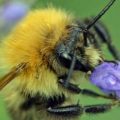
They produce a rich source of pollen and nectar and are primarily pollinated by bumble bees. Bees can actually steal the nectar by biting a hole through the bottom of the flower, without pollinating the plant. They are also visited by other species of bee, as well as butterflies, moths and hoverflies.
Uses for Bluebells
Bluebells are in fact poisonous to humans, cattle, horses and dogs, as they contain toxic glycosides. Ingestion from any part of the plant can cause a lowering of the pulse rate, sickness, diarrhea and vomiting. For some people they can cause skin irritation just by touch.
However, in days gone by, bulbs have been used in traditional medicinal as a diuretic (increases urine production) and as a styptic substance (prevents bleeding when applied to a wound). The bulb and stem produce sap which has been used as glue. In days gone by, the glue has been used to stick feathers to arrows and also used to glue paper together in bookbinding.
The juice from this plant has also been used to cure snakebites, however, because of it’s toxicity, it can be extremely dangerous in large doses. This is of course, one of the reasons bluebells are not used in modern medicines.
Bluebell images
Click to enlarge


This work is licensed under a Creative Commons Attribution 4.0 International License.
You are free to use, share and adapt any of the images on this page, under the condition we receive a followed backlink to our website https://diversegardens.co.uk as the image source.