• Menu
  • Skip to left header navigation
  • Skip to right header navigation
  • Skip to primary navigation
  • Skip to main content
  • Skip to primary sidebar
  • Skip to footer

Before Header

  • Home
  • Blog
  • Cookie Policy (EU)

Diverse Gardens

Creating a wildlife friendly garden

  • Home
  • Blog
  • Cookie Policy (EU)
  • Disclaimer
  • Privacy
  • Search
  • Home
  • Wildflowers
    • How to grow wildflowers
    • Wildflower Gallery
    • Cornfield Annuals
  • Fungi
    • Fungi gallery
  • Bees & Pollinators
    • Types of Bees
    • Impact of Pesticides on Bees
  • Home
  • Wildflowers
    • How to grow wildflowers
    • Wildflower Gallery
    • Cornfield Annuals
  • Fungi
    • Fungi gallery
  • Bees & Pollinators
    • Types of Bees
    • Impact of Pesticides on Bees
Selfheal header

Selfheal

A low-growing, perennial wildflower and as its name suggests, selfheal has medicinal properties. The violet – blue flowers appear between June and September and encourage bees and other pollinators.

You are here: Home / Wildflowers / Wildflower Gallery / Selfheal

Selfheal Prunella vulgaris

Table of Contents

  • Selfheal Prunella vulgaris
    • General information
    • Identification
    • Value for wildlife
    • Uses for selfheal
    • Selfheal images
  • Selfheal: Frequently Asked Questions

Selfheal or heal-all is a low-growing herbaceous plant that produces clusters of violet-purple flowers. It’s an edible plant and as its name suggests it has medicinal properties and is used to treat many illnesses and ailments.

SelfhealPlant family: Lamiaceae

Aliases: Heal-all, hookweed, sicklewort
Flowering period: June – September
Flower colour: Violet – blue
Preferred soil type: Most types
Habitat: Grassland, open woodland, lawns
Status: Common

General information

Selfheal is a low-growing, herbaceous, perennial wildflower that’s native to Europe and other regions of the world. It’s preferred habitat is grassland, such as meadows, roadside verges and turf. It can be a nuisance to gardeners as it’s also common on lawns, but is relatively easy to control.

The bright purple flowers are very similar to those of bugle, to which it’s occasionally mistaken for. It reaches about 30cm in height and isn’t fussy about the soil, it’ll grow on most types and it spreads by seed and vegetatively by creeping runners, rooting at the nodes.

Identification

Selfheal

Flower: The flowers appear in dense clusters on cylindrical terminal heads, they are are violet – purple, 10-15 mm long, are two-lipped and tubular. The upper lip is concave, whilst lower lip is occasionally white and has 3 lobes, with the middle lobe being larger.

Leaves: The leaves are oval – lanced shaped, between 10 – 30 mm long, can be both dark and light green, with prominent veins. The leaf edges are sometime scalloped and the surfaces are mostly smooth, but light hairs are not uncommon.

Value for wildlife

Selfheal is a nectar producing plant and is very attractive to all types of bee, butterflies, hoverflies and birds.
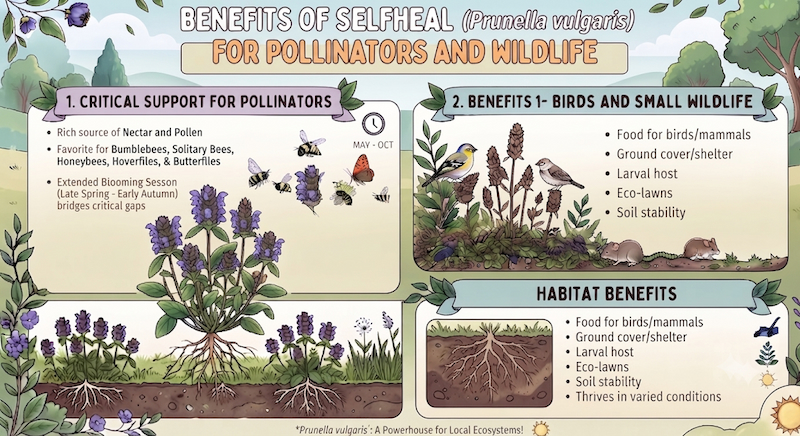
Benefits of Selfheal for polinators

Uses for selfheal

Selfheal is an edible herb and can be consumed raw or cooked. The young leaves added to salads, soup and broths. They can also be used in a pot herb and substitute for spinach

As its name suggests, selfheal has various medicinal properties. It has been used to prevent bleeding, treat viral and respiratory infection, sooth inflammations, cure headaches, treat heart problems and diabetes.

Selfheal images

Click to enlarge

Selfheal
Selfheal
Selfheal
Selfheal

Selfheal: Frequently Asked Questions

What is Selfheal, and where does it grow?
Selfheal is a low-growing, perennial wildflower belonging to the mint family (Lamiaceae). It is native to temperate regions across the Northern Hemisphere, including the UK, where it thrives naturally in lawns, meadows, woodland edges, and rough grassland. It typically grows to a height of 5 to 30 cm, often creeping along the ground and rooting at the nodes to form dense, low carpets.
Why is it called Selfheal?
The common name stems from its extensive historical use in traditional herbal medicine. Folk medicine practitioners used infusions and poultices made from the plant to treat minor wounds, sore throats, and bleeding, believing its physical properties could heal itself and others. Its specific species name, vulgaris, simply means common.
How does Selfheal benefit pollinators?
Selfheal is an exceptional nectar and pollen source for a wide variety of beneficial insects. It is particularly attractive to long-tongued bumblebees, honeybees, butterflies, and hoverflies. Because its flowering period extends from June well into October, it provides a vital, late-season food source when many other meadow flowers have finished blooming.
Is Selfheal a good plant for lawns?
Yes! It’s is one of the best lawn weeds to encourage if you want to support biodiversity. It has a low-growing, prostrate habit that tolerates regular mowing remarkably well, often dropping its flower heads just beneath the blades. It stays green through dry summer spells and adds resilience to turf without requiring fertilisers or extra watering.
How can I encourage Selfheal in my garden or wildflower patch?
Selfheal prefers moist, well-drained soils in full sun to partial shade, though it adapts easily to most soil types (clay, loam, or sandy). To encourage it naturally, reduce the frequency of mowing in sections of your lawn (such as adopting a No Mow May approach) or introduce seeds into bare patches of earth during autumn or spring.

Creative Commons Licence
This work is licensed under a Creative Commons Attribution 4.0 International License.
You are free to use, share and adapt any of the images on this page, under the condition we receive a followed backlink to our website https://diversegardens.co.uk as the image source.

Related content:

WildflowerWildflower Gallery Common dog violetCommon dog violet BugleBugle Dames rocketDame’s rocket Bees & pollinationBees & Pollinators

Primary Sidebar

Subscribe for Updates
We respect your privacy.

Navigation

  • Home
  • Sample Page

Recent Posts

  • The Best Plants to Grow near a Bee House
  • How I built this website
  • Medicinal Plants
  • Edible Plants
  • Helping de-hydrated bees

Recent Comments

  • A WordPress Commenter on Hello world!

Navigation

  • Home
  • Sample Page

Footer

Quote

If the bee disappeared off the surface of the globe then man would only have four years of life left.

No more bees, no more pollination, no more plants, no more animals, no more man.

Albert Einstein

Recent Posts

The Best Plants to Grow near a Bee House
Wordpress LogoHow I built this website
SelfhealMedicinal Plants
Forget Me NotEdible Plants
Bumble BeeHelping de-hydrated bees
Insect HouseHow to Build a Bee House

Site Footer

  • Facebook
  • Flickr
  • Instagram
  • Pinterest
  • YouTube

Copyright © 2026 · Mai Lifestyle Pro on Genesis Framework · WordPress · Log in