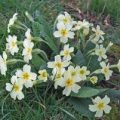
Cowslip Primula veris
Table of Contents

Plant family: Primulaceae
Aliases: Fairy cup, keywort, lady’s keys
Flowering period: April – May
Flower colour: Yellow
Preferred soil type: Most types
Habitat: Grassland, hedgerows, ditch banks, roadside verges
Status: Common
General information
The cowslip is a spring flowering, herbaceous perennial wildflower, that’s a member of the primrose family of plants. Growing to a maximum height of 25 – 30cm, it was once a common sight in meadows, hedgerows, dyke banks and open woodland. However, unfortunately due to loss of habitat caused by modern farming practices, it has since been in steady decline.
It is thought that its name comes from the old English for ‘cow dung’ or ‘cow pat’, because they traditionally grew in meadows where there were cows. Another school of thought on its name, simply referrers to the wet, boggy habitat that this plant is often found.
Cowslips grow well on most soil types, however, they do best when they receive ample sunlight and struggle in shaded locations. They are often confused with the oxlip, which is a hybrid of the cowslip and wild primrose, however the oxlip has a paler flower, which is larger and opens out further, similar to the primrose.
Identification

Flowers: The nodding yellow, tubular, bell shaped flowers measure between 8 – 15mm in diameter, they’re borne in umbels of between 10 – 30 flowers, the inner flower has small orange markings. On rare occasions the flowers may be red.
Leaves: The dark green, heavily wrinkled leaves form as a basal rosette, they measure between 5 – 15 cm long and are similar in appearance to wild primrose.
Value for wildlife
Cowslips provide a valuable source of nectar early in the year to bees and butterflies. The leaves are also the food source for the larvae of the Duke of Burgundy butterfly
Uses for cowslip
Both the leaves and flowers are edible, the leaves can be eaten raw as a salad green or cooked as a vegetable. The flowers have a citrus flavour and can be used in green and fruit salads.
Cowslips also have several medicinal properties and have been used to treat, colds, chest infections, asthma, kidney complaints and arthritis.
Cowslip images
click to enlarge


This work is licensed under a Creative Commons Attribution 4.0 International License.
You are free to use, share and adapt any of the images on this page, under the condition we receive a followed backlink to our website https://diversegardens.co.uk as the image source.