• Menu
  • Skip to left header navigation
  • Skip to right header navigation
  • Skip to primary navigation
  • Skip to main content
  • Skip to primary sidebar
  • Skip to footer

Before Header

  • Home
  • Blog
  • Cookie Policy (EU)

Diverse Gardens

Creating a wildlife friendly garden

  • Home
  • Blog
  • Cookie Policy (EU)
  • Disclaimer
  • Privacy
  • Search
  • Home
  • Wildflowers
    • How to grow wildflowers
    • Wildflower Gallery
    • Cornfield Annuals
  • Fungi
    • Fungi gallery
  • Bees
  • Home
  • Wildflowers
    • How to grow wildflowers
    • Wildflower Gallery
    • Cornfield Annuals
  • Fungi
    • Fungi gallery
  • Bees
Bugle

Bugle

A low growing, creeping wildflower with deep blue flowers that form in spikes, bugle can be seen creating a dense carpet of colour in damp woodlands and meadows

You are here: Home / Wildflowers / Wildflower Gallery / Bugle

Bugle Ajuga reptans

Table of Contents

  • Bugle Ajuga reptans
    • General information
    • Identification
    • Value for wildlife
    • Uses for bugle
    • Bugle images
  • Bugle: Frequently Asked Questions

Bugle is a perennial plant from the mint family and native to Europe. It thrives in shaded conditions such as damp woodland and hedgerows. It’s loved by pollinators, especially bees, it’s edible and has many medicinal properties.

Bugle

Plant family: Lamiaceae
Aliases: Blue bugle, bugle-herb, bugleweed, carpetweed
Flowering period: April – June
Flower colour: Blue – purple
Preferred soil type: Moist
Habitat: Woodland, hedgerows, meadows
Status: Common

General information

A robust plant that’s a member of the mint/dead nettle family, bugle is an erect, perennial wildflower that forms dense mats and can be seen carpeting damp places in open woodland, grassland and hedgerows. The flowers are similar in appearance to selfheal, they’re from the same family and have similar medicinal properties.

A native to Europe, this herb grows up to 40cm in height, with a basal rosette and long, leafy, rhizomatous  runners that spread aggressively and is very invasive, if not kept in check. For theses reasons it’s often used as a ground cover plant as they keep taller brush in check and supress weeds with its thick, dense foliage.

Identification

Bugle flower and leaf

Flowers: The deep blue – purple (on rare occasions white) flowers are borne on erect, hairy stems and are up to are 15mm long. They are similar in appearance to selfheal and ground ivy. 

Leaves: The basal leaves form as a rosette and are ovate to spoon shaped, the upper and stem leaves are un-stalked and borne in opposite pairs. The lower leaves(up to 7cm long) are generally larger than the upper leaves, with all leaves having a smooth, glossy surface and are dark green – purple in colour.

Value for wildlife

This plant is hermaphrodite (contains both male and female organs) and is pollinated by bees, butterflies, hoverflies and moths. See infographic below.
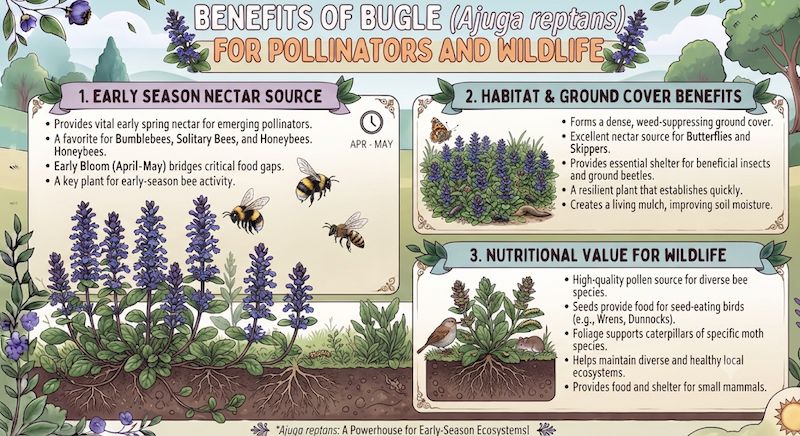
Infographic detailing the wildlife benefits of the bugle wildflower, highlighting its role as a nectar source for bees and butterflies.

Uses for bugle

Bugle has many uses, both as a medicinal and edible herb. The leaves can be used as a potherb in salads, uncooked they taste bitter, but are more palatable when cooked. The roots and tubers can be boiled or cooked.

This perennial herb has a long history of medicinal uses to treat many illnesses and ailments. These include uses as anti-inflammatories, antioxidants and for treatment of respiratory disorders. It has also been used to treat stress and anxiety, hemorrhaging, hangovers and bruising.

Bugle images

Click to enlarge

Close-up of vibrant blue-purple Bugle wildflower blossoms in a damp woodland setting
Erect flowering spike of a Bugle wildflower visited by a pollinating bee
Dense carpet of Bugle wildflowers growing as ground cover in a wild meadow
Bugle Ajuga reptans thriving in its natural shaded habitat along a hedgerow
Low-growing Bugle Ajuga reptans plant showing its dark green and purple glossy leaves
Erect flowering spike of a Bugle wildflower visited by a pollinating bee
Detailed view of glossy basal rosette leaves and deep blue flowers of the Bugle plant

Bugle: Frequently Asked Questions

Is bugle invasive or a good ground cover?
Bugle is not considered invasive, but it is an aggressive, fast-spreading ground cover. It propagates via creeping above-ground runners (stolons) that root as they touch the soil, quickly forming a dense carpet. This makes it an excellent, low-maintenance weed-suppressing ground cover for shady or damp spots where grass struggles to grow.
How do you propagate bugle?
Bugle is remarkably easy to propagate. Because it naturally sends out runners, you can simply lift and divide these rooted sections in spring or autumn and replant them elsewhere in the garden. It can also be grown from seed.
Can you walk on bugle grass?
While bugle can tolerate occasional light foot traffic, it is not a true lawn substitute for heavy use. Frequent walking can crush the succulent stems and flower spikes, though it recovers reasonably well compared to more delicate perennials.
Can bugle grow in full shade?
Yes, bugle is exceptionally shade-tolerant and naturally grows under the canopy of deciduous woodlands. While it adapts well to partial shade and even some morning sun (provided the soil stays moist), deep shade will not stop it from growing, though it may produce slightly fewer flowers.
What companion plants go well with bugle?
Because bugle makes a dense, low-growing carpet with contrasting foliage and blue flower spikes, it pairs wonderfully with taller woodland or shade-loving perennials. Great companions include hostas, ferns, spring bulbs (like daffodils and bluebells), lily of the valley, and Japanese forest grass.

Creative Commons Licence This work is licensed under a Creative Commons Attribution 4.0 International License. You are free to use, share and adapt any of the images on this page, under the condition we receive a followed backlink to our website https://diversegardens.co.uk as the image source.

Related content:

WildflowerWildflower Gallery BluebellBluebell BorageBorage Common comfreyCommon comfrey SelfhealSelfheal

Primary Sidebar

Subscribe for Updates
We respect your privacy.

Navigation

  • Home
  • Sample Page

Recent Posts

  • How I built this website
  • Medicinal Plants
  • Edible Plants
  • Helping de-hydrated bees
  • How to make a bee house

Recent Comments

  • A WordPress Commenter on Hello world!

Footer

Quote

If the bee disappeared off the surface of the globe then man would only have four years of life left.

No more bees, no more pollination, no more plants, no more animals, no more man.

Albert Einstein

Recent Posts

Wordpress LogoHow I built this website
SelfhealMedicinal Plants
Forget Me NotEdible Plants
Bumble BeeHelping de-hydrated bees
Insect HouseHow to make a bee house
WildflowersWhy I built this website

Site Footer

  • Facebook
  • Flickr
  • Instagram
  • Pinterest
  • YouTube

Copyright © 2026 · Mai Lifestyle Pro on Genesis Framework · WordPress · Log in