Betony Betonica officinalis
Table of Contents

Plant family: Lamiaceae
Aliases: Bishop’s wort, common hedge-nettle, purple betony, wood betony
Flowering period: June – October
Flower colour: Deep pink
Preferred soil type: Most types, dry, acidic
Habitat: Grassland, hedgerows, roadside verges, undisturbed field margins
Status: Common
General Information
Betony (Betonica officinalis, formerly Stachys officinalis) is a striking, native British wildflower. It’s known for its spikes of vibrant purple-pink flowers and deep green foliage, it is typically found in wild flower meadows, grassland, roadside verges and shaded woodland margins.
Belonging to the mint family (Lamiaceae), Betony is a hardy, upright herbaceous perennial that has been prized in British gardens and hedgerows for centuries.
Key Botanical Features At-a-Glance
-
Scientific Name: Betonica officinalis (Syn. Stachys officinalis)
-
Common Names: Betony, Wood Betony, Bishop’s Wort
-
Plant Type: Herbaceous perennial
-
Height: 30 cm to 60 cm (1–2 feet)
-
Spread: 30 cm to 45 cm
-
Flowering Period: Mid-summer to early autumn (June to September)
-
Flower Colour: Vibrant purple to pink
-
Preferred Soil Type: Loam, chalk, or clay with good drainage; tolerates neutral to slightly acidic or alkaline conditions.
-
Habitat: Deciduous woodlands, woodland rides, unimproved grasslands, meadows, and hedgerows.
-
Status: Common across the UK, though declining in intensively farmed agricultural regions.
Identification
-
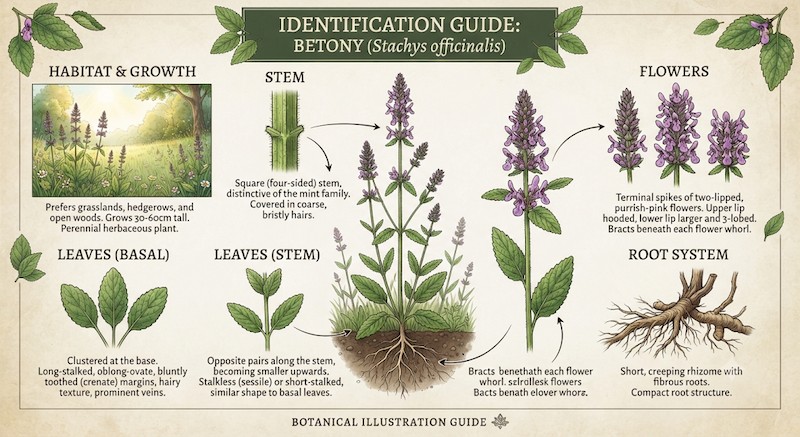
The Flowers: Produces dense, tightly clustered whorls of bright purple-pink, tubular flowers packed into terminal spikes at the top of upright, mostly leafless stems. They bloom from June to October.
-
Leaves & Stems: * Basal Leaves: The lower leaves form as a neat rosette, very close to the ground. They are long-stalked, oblong-oval in shape, with distinct heart-shaped bases and deeply scalloped or crenate (rounded-toothed) margins.
-
Stem Leaves: The upper stems feature only one or two pairs of smaller, stalkless leaves. Stems are covered in hairs and are square, which is a characteristic of plants in the mint family.
Value for Wildlife
Betony is an ecological powerhouse for native pollinators and garden biodiversity, offering vital late-season resources:
-
Pollinator Magnet: The tubular purple flowers are rich in nectar and a favourite among long-tongued insects, particularly bumblebees, solitary bees, and butterflies (such as meadow browns and small skippers). It’s also a favourite of hoverflies.
-
Extended Summer Foraging: Because it flowers continuously from mid-summer well into September, sometimes October, it provides a reliable, late-season food source for pollinators, when many spring-flowering plants have finished.
-
Cover and Habitats: The dense basal rosette provides low-level ground cover and shelter for beneficial ground-dwelling invertebrates, while the upright architectural seed heads offer winter interest.
Uses for Betony
Betony has a rich cultural history and is known for both its practical and herbal uses:
-
Herbal Folklore & Medicinal Uses: Historically, Betony was considered a panacea (cure-all). Known as “Bishop’s Wort,” it was used to brew herbal teas for headaches, anxiety, respiratory ailments, and wound treatment.
-
Natural Dye: The plant contains ingredients that have been historically used to produce a yellow or greenish-yellow dye for wool and natural fabrics.
Betony images
Click to enlarge

This work is licensed under a Creative Commons Attribution 4.0 International License.
You are free to use, share and adapt any of the images on this wildflower gallery page, under the condition we receive a followed backlink to our website https://diversegardens.co.uk as the image source. -